
Why were you charged instalment interest when you paid by April 30?
- 4due dates where the clock starts: March 15, June 15, September 15, December 15
- $25the CRA bills instalment interest only when it’s more than this
- $1,000of instalment interest before any instalment penalty applies
April 30 was too late for the instalments
Paying in full by April 30 means no interest on your balance. But once the CRA sends you a reminder with an amount and you’re required to pay instalments, each instalment has its own due date. Interest runs from each date you missed until April 30, compounded daily. Paying on April 30 stops the clock; it doesn’t turn it back.
You did the thing everyone tells you to do: file, and pay the whole balance by April 30. Then your notice of assessment shows a separate line for instalment interest. It feels like a penalty for paying on time.
It isn’t about April 30 at all. It’s about the four dates before it. Here’s what the CRA charges, why, a worked example with real CRA rates, and what you can still do for 2026.
Mar 15, 2025March instalment, $2,000
$170.42
Jun 15, 2025June instalment, $2,000
$127.10
Sep 15, 2025September instalment, $2,000
$88.98
Dec 15, 2025December instalment, $2,000
$52.85
1. April 30 is for the balance. Instalments have their own dates
There are two different kinds of interest here, and paying by April 30 only avoids one of them.
Interest on your balance
Starts the day after April 30 on anything still unpaid from your return. Pay your balance in full by April 30 and there’s none. This is the part you got right.
Instalment interest
Starts on each instalment due date you missed, or paid short, and runs to April 30. Paying on April 30 stops it there, but the days before that are already counted.
Once you’re expected to pay instalments, the CRA wants the tax during the year: March 15, June 15, September 15 and December 15. Paying it all in one go on April 30 is like paying four bills late on the same day.
2. Three things have to be true
The CRA charges instalment interest only when all three of these apply to the year.
- 1
You had to pay instalments
Your net tax owing was more than $3,000 ($1,800 in Quebec) for the year, and also for one of the two years before.
- 2
A reminder showed an amount
The CRA mails reminders in February (for March and June) and August (for September and December).
- 3
You paid late, short or nothing
Any instalment that came in after its due date, or for less than the CRA’s amount, counts.
If one of the three is missing, there’s no instalment interest. No reminder, or a reminder with no amount: none. A reminder, but your net tax owing for that year turns out to be $3,000 or less: you didn’t have to pay, so none. And if the total comes to $25 or less, the CRA doesn’t charge it.
3. How the CRA works out the charge
It’s two interest calculations, both ending on your balance-due date, and the difference is what you pay.
- DailyInterest is compounded daily at the prescribed rate, which can change every quarter.
- 7%The rate on overdue taxes for every quarter of 2026. It was 8% for January to June 2025, then 7%.
- LeastThe CRA uses the calculation option that gives you the least interest: its reminder amounts, last year’s tax, or this year’s.
Worked example: two reminders ignored in 2025
A hypothetical freelancer owed $8,000 of income tax and CPP each year, so every CRA option gave the same amount: $2,000 a quarter. The February and August 2025 reminders went in a drawer. Nothing was paid until the full $8,000 went in on April 30, 2026.
Each $2,000 that should have been paid earns interest from its own due date. Nothing was paid early, so there’s nothing to subtract.
- Mar 15, 2025: $2,000411 days to April 30, 2026
- $170.42
- Jun 15, 2025: $2,000319 days to April 30, 2026
- $127.10
- Sep 15, 2025: $2,000227 days to April 30, 2026
- $88.98
- Dec 15, 2025: $2,000136 days to April 30, 2026
- $52.85
- Part B: what was paidnothing until April 30, 2026
- $0.00
- Charged (A − B)
- $439.34
- $439.34charged, because it’s more than $25
- $0instalment penalty: the interest is under $1,000
- 5.5%extra on the $8,000 of tax, on top of paying it all
The same freelancer, two other ways. Catching up on December 15 only stops the first three clocks early. Paying each reminder on time means there’s nothing to charge.
about $439
- Paid$8,000 on April 30, 2026
- $8,000
- Instalment interest
- $439.34
about $228
- Paid$8,000 on December 15, 2025
- $8,000
- Instalment interest
- $227.96
$0
- Paid$2,000 on each due date
- $8,000
- Instalment interest
- $0.00
These are estimates. They use the nominal due dates and daily compounding at the published rates. The CRA’s own figure can be a little different, for example when a due date falls on a weekend. Your notice of assessment shows the real number.
The penalty only starts above $1,000
In the example, the interest stayed well under $1,000, so there was no penalty. A penalty is added only when your instalment interest for the year is more than $1,000. The CRA works it out like this:
- Actual instalment interestwhat was charged for the year
- $2,500
- Interest if nothing had been paid25% of it is $800
- $3,200
- Take off the larger of $1,000 or $800$2,500 − $1,000 = $1,500
- −$1,000
- Penalty: half of what’s left
- $750
What to do about 2026 now
If you’ve ignored your 2026 reminders too, there’s still time to cut the charge before the year ends.
- Check whether you really have to pay. If your net tax owing for 2026 will be $3,000 or less ($1,800 in Quebec), you don’t have to pay instalments for 2026, even with a reminder. The instalments guide explains the rule.
- Pay what you missed by December 15, 2026. Paying early, or more than required, earns credit interest that offsets interest on late payments for the same year. In the example above, catching up in December cut the charge from about $439 to about $228. See the December 15 guide for how to pay.
- Know what credit interest can’t do. It isn’t refunded, and it only offsets instalment interest for the same tax year.
- Still pay any balance by April 30, 2027, so there’s no interest on the balance either.
Stop it happening again. Move a share of every payment you receive into a separate tax account, so the money is there on each due date. Here’s how to work out what to set aside, with a 2026 example.
Can you get the interest cancelled?
You can ask, using taxpayer relief (Form RC4288), within 10 calendar years. It isn’t guaranteed, and the CRA looks for reasons like these:
- Outside your controlA natural disaster, a postal strike, a serious illness or accident, or a death in your immediate family.
- CRA error or delayThe CRA gave you wrong information, made a processing error, or was slow to give you what you needed.
- Can’t payPaying the interest would cause you real financial hardship.
If you simply didn’t act on a reminder, none of these fits, so plan on the charge standing. If one does apply, explain what happened on the form and include anything that backs it up.
Tracking it
The reminder amount is easier to pay when you already know roughly what your year looks like. Keeping your income and expenses current lets you see a big year coming before the August reminder does.
Know your profit every quarter, so the reminder amount isn’t a surprise
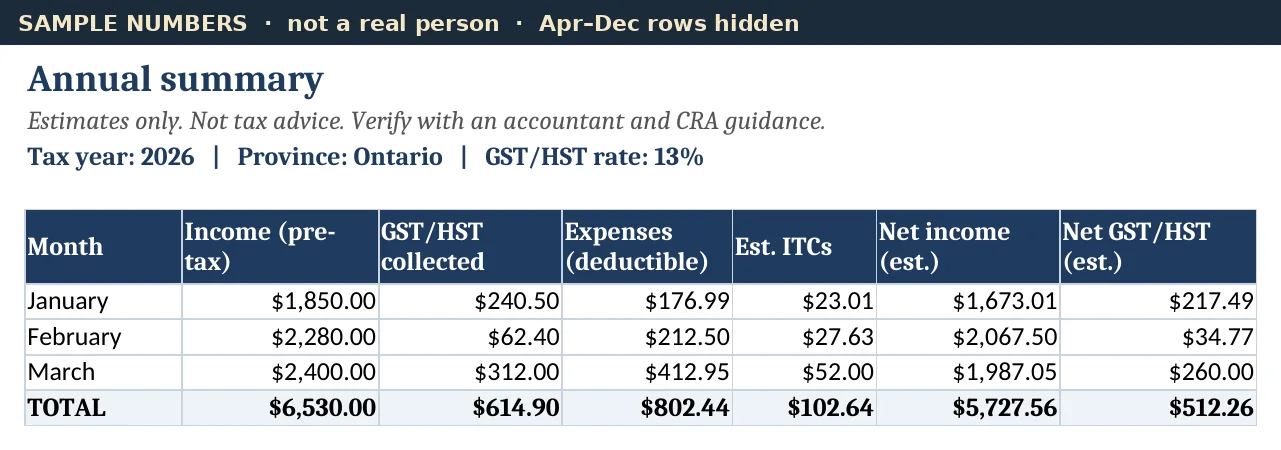
- Every invoice with its GST/HST
- Expenses by T2125 line
- Monthly income and profit
- GST/HST collected and paid
The Canada Self-Employed Income, Expense & GST/HST Tracker is a spreadsheet for Excel and Google Sheets. It doesn’t calculate instalments or interest; it keeps the income and expense totals you need to estimate them.
FAQ
Why was I charged instalment interest if I paid my taxes by April 30?
Because April 30 is the due date for your balance, not for instalments. If you were required to pay instalments and a CRA reminder showed an amount, each instalment was due on March 15, June 15, September 15 or December 15. Interest runs from each missed date to April 30, compounded daily.
Do I have to pay instalments just because I got a reminder?
No. You have to pay instalments for 2026 only if your net tax owing is more than $3,000 ($1,800 in Quebec) for 2026 and for 2025 or 2024. If you get a reminder but your 2026 net tax owing ends up at $3,000 or less, you don't have to pay. If it ends up higher and you skipped the reminders, interest can apply.
How much is instalment interest?
It's charged at the CRA's prescribed rate for overdue taxes, compounded daily: 7% in every quarter of 2026, and 8% then 7% in 2025. In the hypothetical example on this page, four missed $2,000 instalments in 2025, paid on April 30, 2026, came to about $439. The CRA doesn't charge it if the total is $25 or less.
Is there a penalty on top of the interest?
Only if your instalment interest for the year is more than $1,000. The penalty is half of the amount by which your instalment interest is more than $1,000 or 25% of the interest you'd have been charged with no instalments at all, whichever is greater.
Can I still reduce my 2026 instalment interest?
Yes. Paying your next instalment early, or paying more than required, earns credit interest that offsets instalment interest for the same year. December 15, 2026 is the last 2026 instalment date. Credit interest isn't refunded and can't be used for another year.
Can I ask the CRA to cancel instalment interest?
You can ask for taxpayer relief with Form RC4288 within 10 calendar years. The CRA considers things like disasters, serious illness, CRA errors or delays, and financial hardship. Relief isn't guaranteed, and ignoring a reminder isn't one of those reasons.
Sources
- CRA: Instalment interest and penalty charges
- CRA: Who has to pay instalments
- CRA: Options to calculate your instalments
- CRA: Required tax instalments for individuals (due dates)
- CRA: Interest and penalties on late taxes (interest on your balance owing)
- CRA: Prescribed interest rates, first quarter 2025 (8% on overdue taxes; also 8% in Q2)
- CRA: Prescribed interest rates, third quarter 2025 (7%; also 7% in Q4)
- CRA: Prescribed interest rates, fourth quarter 2026 (7%; 7% in every quarter of 2026)
- CRA: Cancel or waive penalties and interest
- CRA: Form RC4288, Request for Taxpayer Relief