
Is there any benefit to registering for GST/HST under $30,000?
- OptionalUnder $30,000 you don't have to register, but you can if you make taxable sales
- ITCsOnce registered, you may claim input tax credits for GST/HST paid on business purchases
- 1 yearThe minimum time registered before you can cancel, unless you stop your commercial activities
It depends
Registering lets you claim input tax credits for the GST/HST you pay on business purchases, and you get a refund in any period where they're more than the tax you charged. In return you have to charge GST/HST on your taxable sales, file a return for every reporting period and stay registered for at least a year. Who your clients are matters: registered businesses can usually claim back the GST/HST you charge, consumers can't.
Under $30,000 of taxable revenue you're a small supplier, so you don't have to register for GST/HST. You can still choose to, as long as you make taxable sales in Canada. You generally can't register if you provide only exempt supplies.
The question comes up two ways: "is there any benefit to registering early?" and "should I keep my revenue under $30,000 to avoid it?" Both come down to the same trade-off, laid out here with the CRA's rules.
What changes the day you register
Not registered
Small supplier
- You don’t charge GST/HST (other than on certain taxable supplies of real property)
- You can’t claim input tax credits
- No GST/HST returns to file
Registered voluntarily
GST/HST registrant
- You charge, collect and remit GST/HST on your taxable sales
- You file GST/HST returns on a regular basis
- You may claim input tax credits on your purchases and operating expenses
- You stay registered for at least one year before you can cancel, unless you stop your commercial activities
The possible benefits
- Benefit Input tax credits. You may recover the GST/HST paid or payable on purchases and expenses you use in your business.
- Benefit A refund when credits are bigger. If the GST/HST you charged in a period is less than your input tax credits, you can claim a refund of the difference.
- Benefit Credits on what you already own. As a new registrant who was a small supplier, you may claim input tax credits on property you still hold for your business, such as equipment or inventory. See claiming GST/HST paid before you registered.
- Benefit Exports keep their credits. Most services to non-resident clients are zero-rated: you charge 0% but can still claim input tax credits on the costs of making those sales. See GST/HST and US clients.
Close to $30,000 anyway? Once you go over the limit you have to register, within 29 days. Registering before you get there means there’s no missed period to sort out later. See what happens if you go over $30,000 without charging.
The costs and obligations
- Cost You charge GST/HST on your taxable sales, including to clients who can’t claim it back. Only registrants claim input tax credits, so for consumers and unregistered clients the GST/HST adds to what they pay.
- Cost A return for every reporting period, even when you have no net tax to remit and no business transactions. Most registrants must file electronically, and a late return can bring a penalty if you owe money.
- Cost More on your invoices. Registered business clients need your GST/HST registration number on invoices of $100 or more to support their input tax credit claims.
- Cost At least a year. You have to stay registered for at least one year before you can cancel, unless you stop your commercial activities.
Cancelling later isn’t a clean reset. When you stop being a registrant, you may have to account for GST/HST on business property you still hold. In the CRA’s example, a registrant who claimed a full input tax credit on a computer includes tax on it in their final return.
Who your clients are changes the picture
The GST/HST on your invoice lands differently depending on who pays it.
The same quarter, two ways
A hypothetical Ontario freelancer whose clients are all GST/HST-registered businesses, to show how the numbers move. It’s an illustration only: your own sales, costs and clients decide it.
- Invoices for the quarter
- $6,000.00
- HST charged
- $0.00
- Business purchases
- $1,500.00
- HST paid on them (13%)
- $195.00
- Input tax credits
- $0.00
- HST that stays part of your costs
- $195.00
- Invoices for the quarter
- $6,000.00
- HST charged (13%)
- $780.00
- Business purchases
- $1,500.00
- HST paid on them (13%)
- $195.00
- Input tax credits
- − $195.00
- Net tax remitted$780.00 − $195.00
- $585.00
Reading the example. Registered, the freelancer charges $780 of HST, claims back the $195 paid on purchases and remits $585, and files a return. Their registered clients can generally claim the $780 as input tax credits. If those clients were consumers, the $780 would simply be added to what they pay.
If you decide to register
- Register for a GST/HST account with the CRA. Business Registration Online is the online option.
- Pick your effective date. As a small supplier it’s usually the date of your request, and it can generally be up to 30 days before that. From that date you charge GST/HST on your sales and can claim input tax credits.
- Know your reporting period. The CRA generally assigns an annual period if your taxable revenue is $1,500,000 or less, and you can choose to file more often. An annual filer who is a sole proprietor with a December 31 year-end pays by April 30 and files by June 15. See how to file a GST/HST return.
- Look at the Quick Method. Businesses with annual worldwide taxable supplies of $400,000 or less (including GST/HST) can generally elect it, though some professions are excluded. See the Quick Method explained.
Tracking it
Whichever way you go, log the GST/HST shown on every business receipt and add up your revenue by quarter. Before you register, those receipts show roughly how much GST/HST you pay on business costs. Once you’re registered, they back up your input tax credit claims.
Weighing it up? See the GST/HST on your costs first
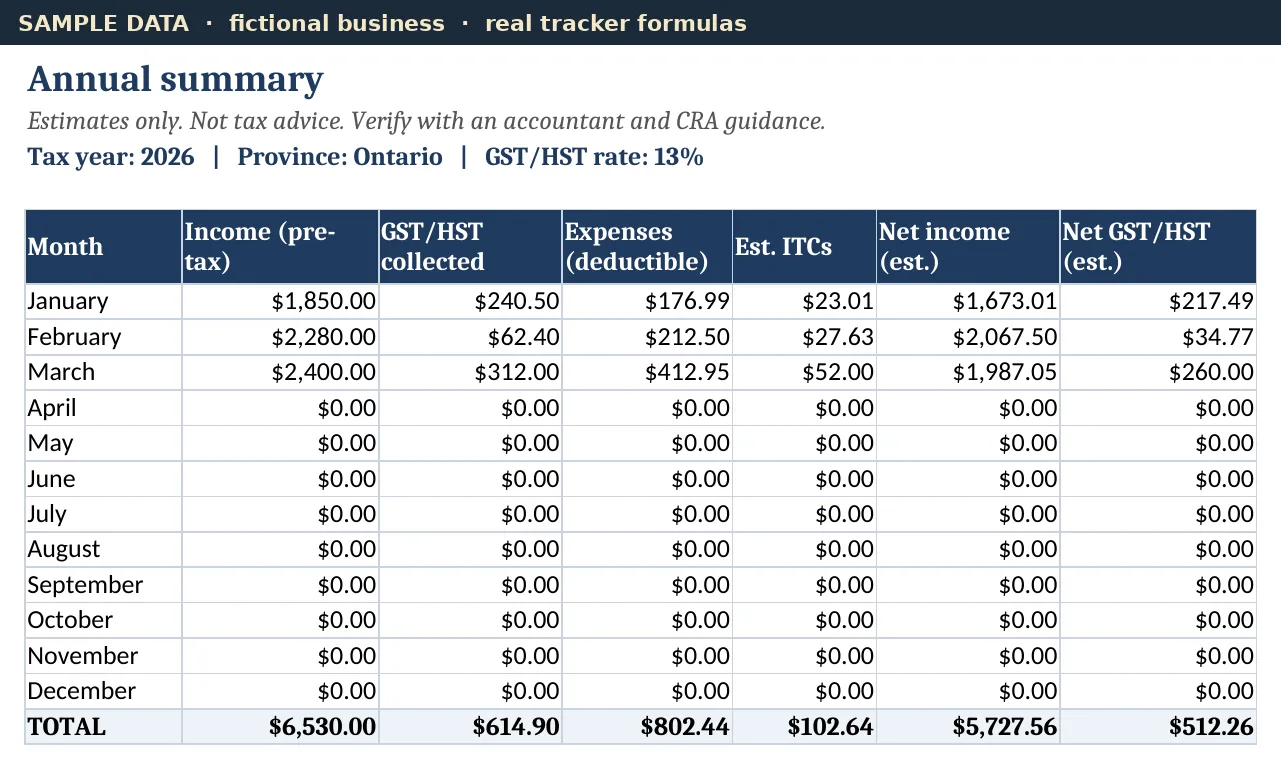
- GST/HST paid on every receipt
- Estimated input tax credits
- Income and GST/HST by month
- A registered or not setting
The Canada Self-Employed Income, Expense & GST/HST Tracker is a spreadsheet for Excel and Google Sheets. It organizes your numbers; it doesn't decide whether you should register.
Checking where you stand on the limit? See the $30,000 small supplier rule explained.
FAQ
Is it worth registering for GST/HST under $30,000?
It depends on your situation. Registering lets you claim input tax credits on business purchases, and you can get a refund when they're more than the GST/HST you charge. But you then charge GST/HST on your taxable sales, file a return for every reporting period and stay registered for at least a year. Clients who are GST/HST registrants can usually claim back the tax you charge; consumers can't.
Can I register for GST/HST if I make less than $30,000?
Yes. A small supplier may register voluntarily if it makes taxable supplies in Canada. You generally can't register if you provide only exempt supplies.
Do I have to charge GST/HST if I register voluntarily?
Yes. From your effective date of registration you charge, collect and remit GST/HST on your taxable supplies like any other registrant, even though your revenue is under $30,000.
What date does a voluntary registration start?
Usually the date you ask to register. It can generally also be up to 30 days before that day. A corporation's effective date can't be before its incorporation date.
Can I cancel a voluntary GST/HST registration?
Generally only after you've been registered for at least one year, unless you stop your commercial activities. When you stop being a registrant, you may have to account for GST/HST on business property you still hold.
Should I keep my revenue under $30,000 to avoid GST/HST?
That's a business decision only you can make. The CRA rule itself is simple: once you go over $30,000 in a single calendar quarter or over four consecutive quarters, you have to register. Below that, registering is your choice, so compare the input tax credits you could claim with the GST/HST your clients would pay and the extra filing.
Sources
- CRA: Register voluntarily for a GST/HST account
- CRA: When to register for and start charging the GST/HST
- CRA: Input tax credits
- CRA: Guide RC4022, General Information for GST/HST Registrants
- CRA: GST/HST Memorandum 8-5, Becoming and Ceasing to be a Registrant
- CRA: GST/HST reporting requirements and deadlines
- CRA: GST/HST filing penalties