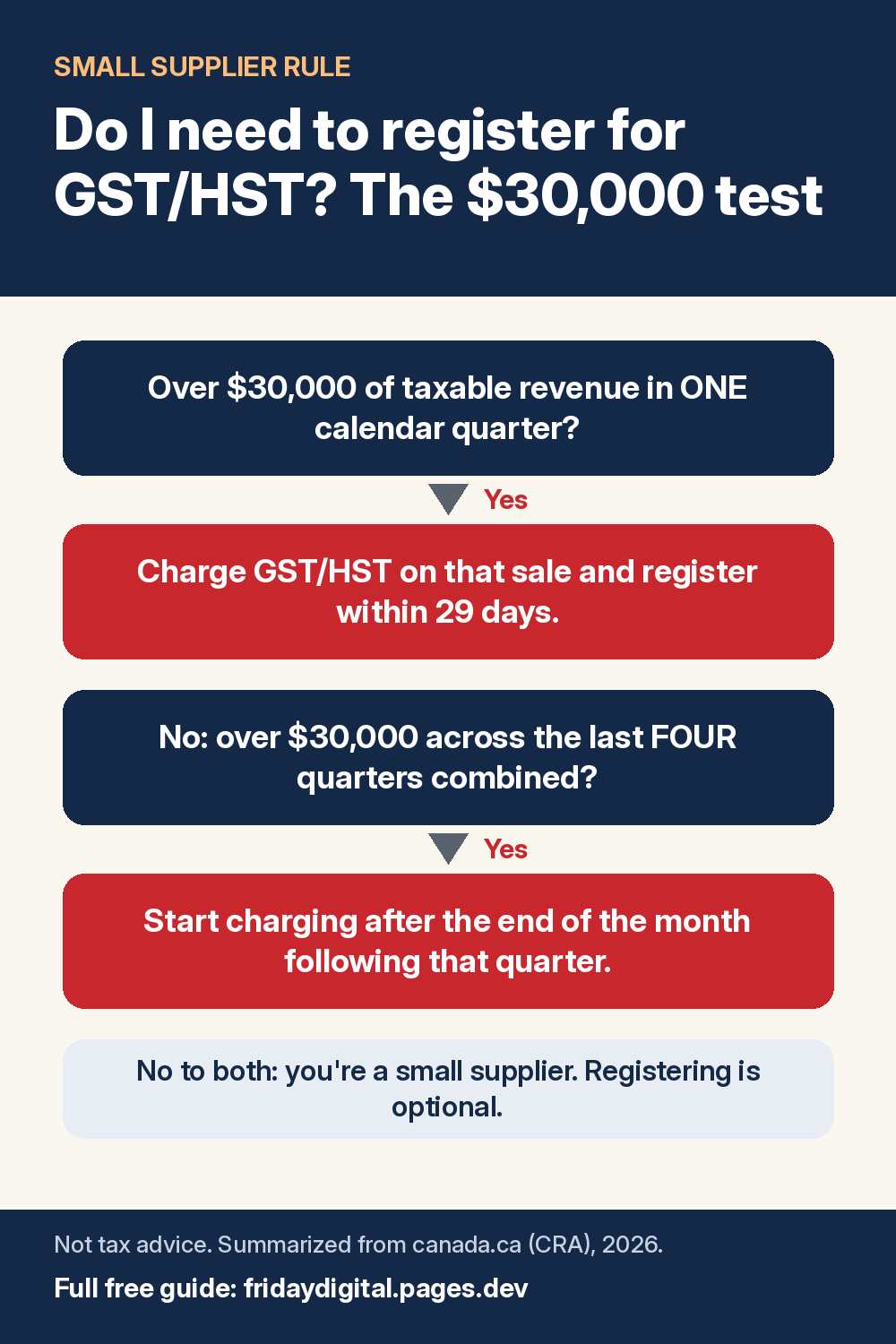
Most self-employed people in Canada don't have to register for GST/HST until they stop being a small supplier. Here's how the CRA's test works for most businesses. Charities and public service bodies use different limits.
| Situation | Result |
|---|---|
| Your taxable revenue does not go over $30,000 in any four consecutive calendar quarters | You're a small supplier. You don't have to register, but you can register voluntarily. |
| You go over $30,000 in a single calendar quarter | You stop being a small supplier right away. You charge GST/HST on the sale that took you over, and register within 29 days. |
| You go over $30,000 across the last four (or fewer) quarters, but not in one quarter | You stop being a small supplier at the end of the month after the quarter you went over. You start charging on your first sale after that. |
Calendar quarters are January to March, April to June, July to September and October to December.
A freelance designer bills $6,000, $8,000, $9,000 and $5,000 over four quarters, for $28,000 total. They're still a small supplier. If the next quarter is $9,000, the latest four quarters add up to $31,000 ($8,000 + $9,000 + $5,000 + $9,000). They stop being a small supplier at the end of the month after that quarter.
Add up your taxable revenue by calendar quarter as you go, so you can see when you're getting close to $30,000.
Want this in a spreadsheet? The Canada Self-Employed Income, Expense & GST/HST Tracker ($19 CAD, Excel/Google Sheets) does these totals for you.