Tracking GST/HST comes down to two lists: tax you collected on sales, and tax you paid on business purchases. Here's a simple system, with links to the official CRA rules.
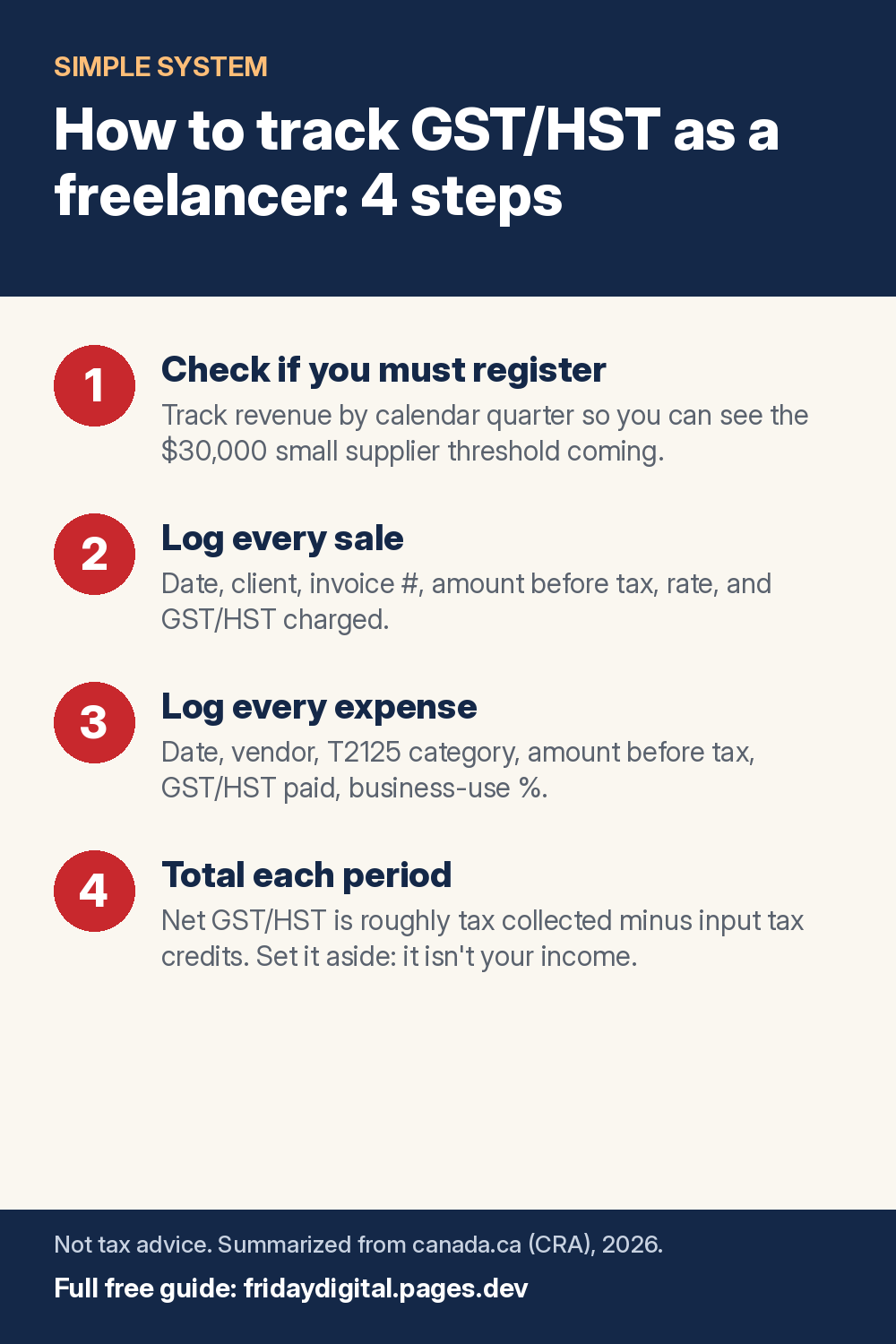
Read the small supplier $30,000 explainer. Even if you're not registered yet, track your revenue by calendar quarter so you can see the threshold coming.
Record the date, client, invoice number, amount before tax, GST/HST rate, and GST/HST charged.
Record the date, vendor, T2125 category, amount before tax, GST/HST paid, and business-use %.
Net GST/HST is roughly the GST/HST collected minus input tax credits. Put money aside for it, because it isn't your income.
Generally only once you're no longer a small supplier, meaning more than $30,000 of taxable revenue in a single calendar quarter or over four consecutive quarters. Taxi and ride-share drivers must register regardless. You can also register voluntarily.
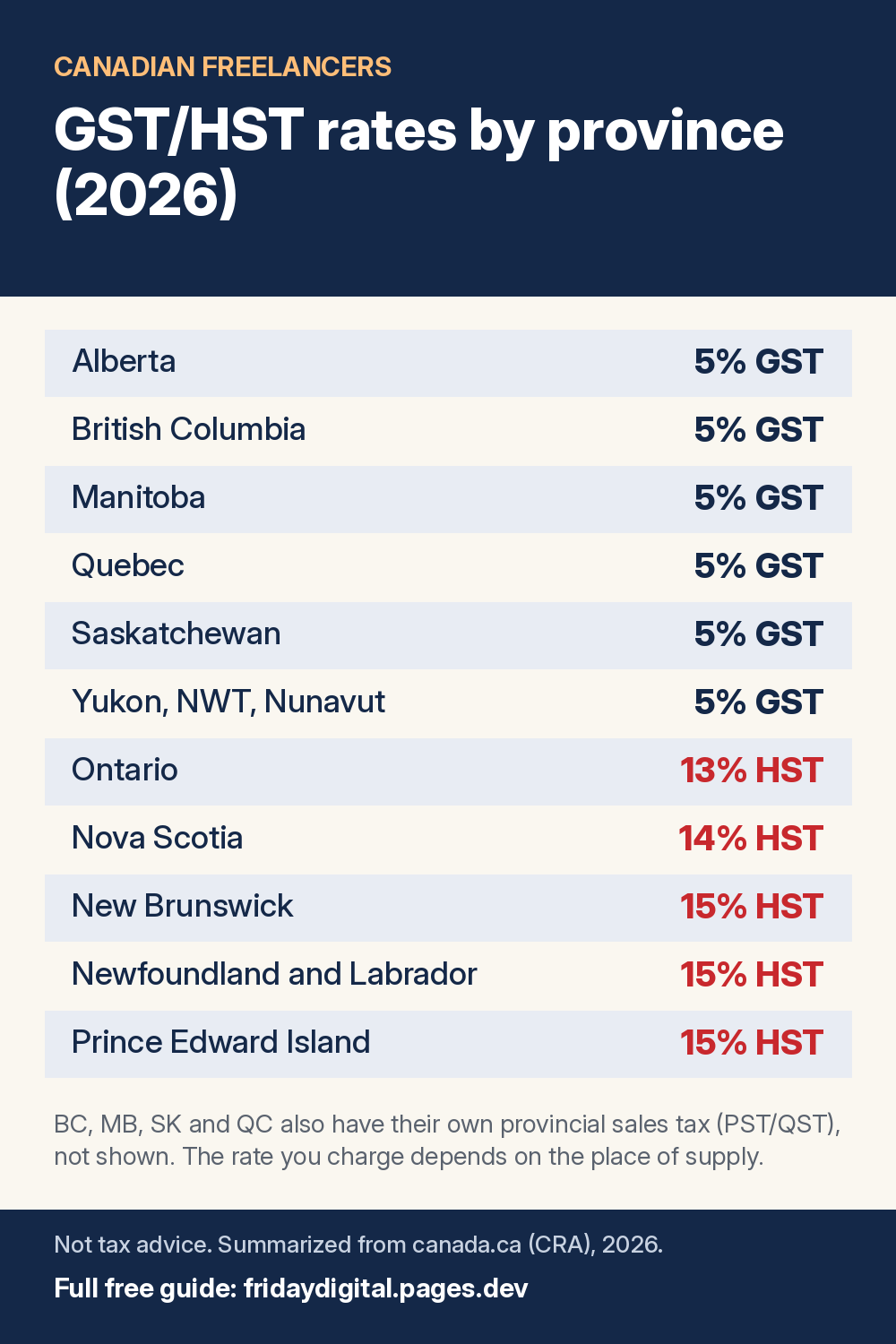
It depends on the place of supply. As of 2026 it's 5% GST in AB, BC, MB, QC, SK and the territories, and HST of 13% in ON, 14% in NS, and 15% in NB, NL and PE. Check the CRA rates page and the place-of-supply rules.
For every invoice, record the amount before tax, the GST/HST you charged, and the rate used. For every business expense, record the amount before tax and the GST/HST you paid. Then add them up for each reporting period.
If you're registered, you can generally recover the GST/HST you paid on business purchases by claiming input tax credits (ITCs) on your return. Your net tax is the GST/HST collected minus your ITCs. For mixed personal and business use, claim only the business portion. Meals and entertainment are generally limited to 50%.
Many services and intangibles supplied to non-residents are zero-rated (taxed at 0%), but the rules have conditions. Check CRA guidance or ask an accountant before applying 0%.
Want this in a spreadsheet? The Canada Self-Employed Income, Expense & GST/HST Tracker ($19 CAD, Excel/Google Sheets) does these totals for you.