
How should you set aside money for taxes as a sole proprietor?
- 3separate amounts: GST/HST, CPP and income tax, each worked out on its own
- 11.9%CPP on 2026 profit between $3,500 and $74,600
- Apr 302027: when the 2026 balance is due, even though you file by June 15
Three buckets, not one guess
Every time a client pays you, move three amounts out of your spending money: all the GST/HST on the invoice if you’re registered, CPP at 11.9% of your profit, and income tax worked out from the 2026 brackets for your province. A single percentage from a forum will be wrong for most people, because the right number depends on your profit, your province and your credits.
If you keep guessing and getting it wrong, the problem is usually the method, not your math. One percentage for everything mixes up three different bills: GST/HST you collected for the CRA, CPP on your profit, and income tax that climbs through brackets.
Split them, and each one becomes something you can work out. Below is the method, then a full worked example with the 2026 CRA figures.
- $260.00GST/HST bucketAll the HST on the invoice (13%)
- $186.76CPP bucketIts share of the year’s $6,723.50 CPP
- $218.87Income tax bucketIts share of the year’s $7,879.43 income tax
- $1,594.37Yours to spendRent, groceries, your own pay
1. GST/HST: set aside all of it
If you’re registered, the GST/HST on your invoices was never your money. The CRA says you hold it in trust until you send it in, and that includes tax you’ve charged but haven’t been paid yet.
What to move
The full GST/HST amount on every invoice, the day the client pays. On a $2,000 Ontario invoice, that’s the $260 of HST, not a percentage of it.
What comes back
Input tax credits for the GST/HST you paid on business costs reduce what you send. What’s left in the bucket after you file is yours.
Not registered yet? Then you don’t charge GST/HST and this bucket stays empty. Keep an eye on the $30,000 small supplier limit, and see how to track GST/HST once you register.
2. CPP: 11.9% of your profit, with two limits
As an employee, half your CPP comes off your pay. Self-employed, you pay both halves on your profit, not your sales.
Free tool: enter your expected profit in the self-employed CPP calculator to get your 2026 CPP, CPP2 and a monthly set-aside amount. The CPP guide explains the rules.
3. Income tax: pick one of three ways to estimate
Income tax is the hard bucket, because each slice of income is taxed at its own rate and credits come off the top. Use whichever of these fits your year.
2026 federal brackets, on taxable income
- 14%$0 to $58,523
- 20.5%$58,523 to $117,045
- 26%$117,045 to $181,440
- 29%$181,440 to $258,482
- 33%over $258,482
Your province or territory adds its own tax on top, with its own brackets. The CRA lists them all on its 2026 tax rates page (Quebec residents use Revenu Québec’s rates).
Worked example: $60,000 of profit in Ontario
This is a hypothetical sole proprietor in Ontario: $72,000 of revenue in 2026, $12,000 of business expenses, so $60,000 of profit. No other income, no RRSP, and only the basic personal amount and CPP credits.
The steps follow the CRA’s own step-by-step tax calculation for Ontario, with the 2026 figures.
- Profit (net self-employment income)
- $60,000.00
- Minus the $3,500 basic exemption($60,000 − $3,500) = $56,500
- × 11.9%
- CPP for 2026
- $6,723.50
- Profit
- $60,000.00
- Minus the CPP deduction (line 22200)
- − $3,926.75
- Taxable income
- $56,073.25
- $0 to $56,073.25 at 14%
- $7,850.26
- Minus credits: 14% of ($16,452 basic personal amount + $2,796.75 CPP)
- − $2,694.83
- Federal tax
- $5,155.43
- $0 to $53,891 at 5.05%
- $2,721.50
- $53,891 to $56,073.25 at 9.15%
- $199.68
- Minus credits: 5.05% of ($12,989 Ontario basic personal amount + $2,796.75 CPP)
- − $797.18
- Basic Ontario taxUnder $5,818, so no Ontario surtax; over $600, so no Ontario tax reduction
- $2,124.00
- Plus the Ontario Health PremiumTaxable income between $48,000 and $72,000
- + $600.00
- Ontario tax
- $2,724.00
- CPP (step A)
- $6,723.50
- Federal tax (step C)
- $5,155.43
- Ontario tax (step D)
- $2,724.00
- Total to set aside
- $14,602.93
- $1,216.91a month, if you save it evenly over 12 months
- 24.34%of the $60,000 profit
- 20.3%of each payment you receive, before GST/HST, on $72,000 of revenue
This is an estimate. Your real bill will differ if you have other income, RRSP contributions, other credits or deductions, or live in another province. Use it to set money aside, then let your tax return decide the final number.
Why one percentage doesn’t work
Run the same hypothetical person with a bigger year. The share of profit that goes to CPP and tax changes, because more income lands in higher brackets, even though CPP stops growing.
24.34%
- CPP
- $6,723.50
- Federal + Ontario tax
- $7,879.43
- Total
- $14,602.93
28.19%
- CPP and CPP2$8,460.90 maximum + $832 CPP2
- $9,292.90
- Federal + Ontario taxPart of the income is now in the 20.5% federal and 9.15% Ontario brackets
- $16,079.97
- Total
- $25,372.87
Turn it into a habit for every payment
- Open separate savings buckets. One for GST/HST, one for CPP and income tax (or one each). Keeping them out of your everyday account is what stops the guessing.
- Move the money the day a client pays. All the GST/HST, plus your own percentage of the rest. In the example, that’s 20.3% of each payment before GST/HST.
- Re-check every quarter. Put your actual profit so far into the same steps. If you’re ahead of plan, move a top-up; if a client left, you can ease off.
- Pay from the buckets on the dates below, not from your spending account.
When the money leaves your buckets
- Last 2026 instalment, if the CRA expects instalments from you. See the December 15 guide.
- First 2027 instalment, if you have to pay instalments for 2027. The others are June 15, September 15 and December 15.
- Pay any income tax and CPP still owing for 2026. GST/HST annual filers with a December 31 year-end pay theirs by now too.
- File your 2026 income tax return (and the annual GST/HST return, for those filers).
Who pays instalments. You have to pay instalments for 2026 if your net tax owing is more than $3,000 ($1,800 in Quebec) for 2026 and also for 2025 or 2024. For the example above, a $14,602.93 bill used as the base under the prior-year option would mean about $3,651 each quarter. See CRA instalments explained.
Tracking it
All three buckets start from the same two numbers: what you invoiced, with the GST/HST on it, and what you spent. Keep those up to date and the quarterly re-check takes minutes.
Know your profit every month, so your set-aside isn’t a guess
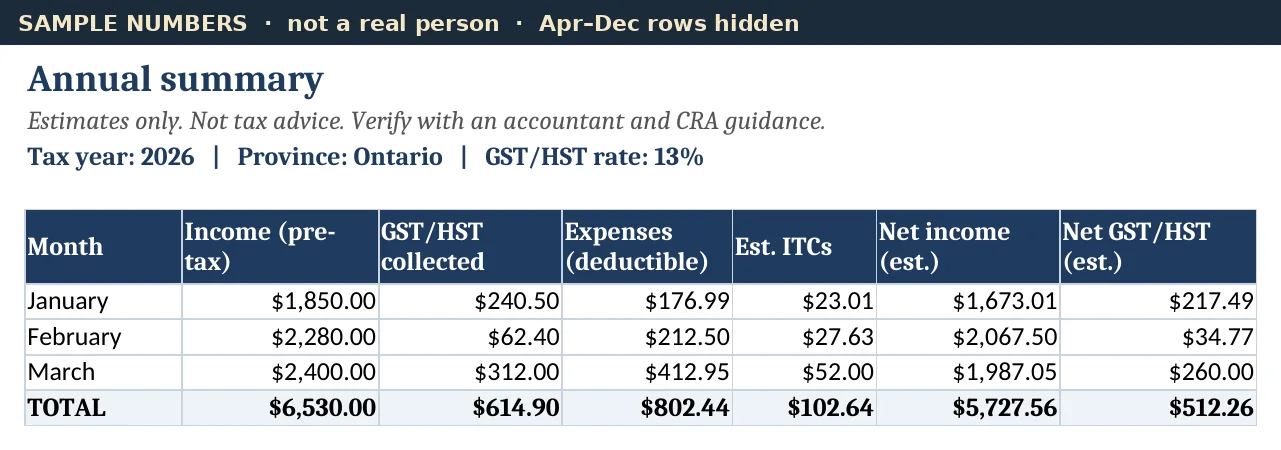
- Every invoice with its GST/HST
- Expenses by T2125 line
- Monthly income and profit
- GST/HST collected and paid
The Canada Self-Employed Income, Expense & GST/HST Tracker is a spreadsheet for Excel and Google Sheets. It doesn’t calculate your income tax; it keeps the income, expense and GST/HST totals you need to work it out.
FAQ
Is there a standard percentage I should set aside for taxes?
No single percentage fits everyone. Income tax depends on your profit, your province and your credits, and CPP is 11.9% only on 2026 profit between $3,500 and $74,600. In the hypothetical Ontario examples on this page, CPP and income tax came to 24.34% of a $60,000 profit and 28.19% of a $90,000 profit. Work out your own figure and re-check it each quarter.
Do I set aside the GST/HST too?
If you're registered, yes, all of it. The CRA says you hold the GST/HST you charge in trust until you send it in, including tax you've charged but haven't been paid yet. Input tax credits for the GST/HST you paid on business costs reduce what you send.
Do I have to pay instalments in my first year?
Often not. You have to pay instalments for 2026 only if your net tax owing is more than $3,000 ($1,800 in Quebec) for 2026 and also for 2025 or 2024. So a first big year is usually paid as one balance on April 30. In the next year, you may owe that balance and instalments for the new year in the same spring.
I also have a job. How does that change things?
Your employer already takes tax and CPP off your pay. Schedule 8 counts the CPP on your T4 slips, so you owe less CPP on your business profit; the CPP calculator lets you enter your T4 earnings. But your salary uses up the lower tax brackets first, so each dollar of business profit can be taxed at a higher rate.
Should I use last year's numbers or this year's rates?
If this year looks like last year, last year's actual bill is the simplest guide; the CRA's prior-year instalment option is based on it too. If your income is changing a lot, or it's your first year, estimate this year with the 2026 rates, as in the worked example.
Does this work in Quebec?
Not as written. Quebec residents contribute to the QPP instead of the CPP, file a separate Quebec return with Revenu Québec, and have a $1,800 instalment threshold instead of $3,000.
Sources
- CRA: Current year tax rates and income brackets (2026)
- CRA: Payroll Deductions Tables, Ontario, January 2026 (2026 basic personal amounts, Ontario surtax, health premium and tax reduction, and the CRA step-by-step tax calculation)
- CRA: Indexation adjustment for personal income tax and benefit amounts (2026)
- CRA: CPP contribution rates, maximums and exemptions
- CRA: Who has to pay instalments
- CRA: Charge and collect the GST/HST (what to do with collected GST/HST)
- CRA: Guide RC4022, General Information for GST/HST Registrants
- CRA: GST/HST reporting requirements and deadlines