
How do you fill out Form T2125, line by line?
- 8299your gross business income, also entered on line 13499 of your return
- 9945business-use-of-home: claimed last, and it can’t create or increase a loss
- 9946your net income, which goes on line 13500 (business), 13700 (professional) or 13900 (commission)
Top to bottom, home office last
Fill in who you are (Part 1), then your sales with the GST/HST you charged taken back out (Part 3). Subtract your business expenses (Part 4), then work out your home office in Part 7 and take it off in Part 5. What’s left on line 9946 is the profit you carry to your T1 return.
Form T2125 is where you report your business or professional income and expenses as a sole proprietor or freelancer. It has nine parts, but you only fill in the ones that apply to you. If you have more than one business, you fill in a separate T2125 for each.
This guide goes through it in the order the form does. Line numbers are from the 2025 form and the 2025 Guide T4002, the latest the CRA has published. The CRA puts out the 2026 version before tax season, so check the numbers still match when you file.
- Part 1
Identification
Your name, the business, its year and its industry code.
Everyone - Part 2
Internet business activities
Websites and the share of income they bring in.
If you earn online - Part 3
Income
Sales or fees, with GST/HST taken out. Ends at line 8299.
Everyone - Part 3D
Cost of goods sold
Inventory and purchases for products you sell.
If you sell goods - Part 4
Expenses
Lines 8521 to 9270, vehicle and CCA. Ends at line 9369.
Everyone - Part 5
Net income
Adjustments, home office, then line 9946.
Everyone - Part 6 & 8
Partnerships
Other income, expenses and partners.
Partners only - Part 7
Business-use-of-home
The home office worksheet that feeds line 9945.
If you work from home - Part 9
Details of equity
Liabilities, drawings and capital you put in.
Fill in what applies
Meet Maya, a hypothetical example. Maya is a freelance graphic designer in Ontario, registered for GST/HST, with a December 31 year-end. In 2025 she invoiced $60,000 of fees plus 13% HST, works from a rented apartment and bought no equipment. Her numbers are made up to show how the form works; yours will be different.
1. Identification: who you are and which year
Part 1 asks for your name and SIN, the business name and address, your main product or service, and the fiscal period the form covers. With a December 31 year-end, that’s January 1 to December 31, 2025.
- Industry codeThe 6-digit code for your main business activity (more than 50% of what you do), from the North American Industry Classification System (NAICS) list in Guide T4002.
- Program account numberThe 15-character number the CRA gave your business, if it has one.
- Tax shelter and partnership numbersLeave them blank unless they apply to you.
- Prepared byThe name and address of whoever filled in the form, if it wasn’t you.
Part 2 is for internet business activities: how many websites or web pages earn you income, up to five addresses, and the percentage of your gross income that comes from them.
2. Income: start with what clients paid, then take the GST/HST out
Business income goes in Part 3A. If your work counts as professional income, you use Part 3B instead, which works the same way and also counts work in progress. The CRA wants a separate T2125 for business and for professional income.
On line 3A, enter your gross sales, commissions or fees, including the GST/HST you collected or could collect. On 3B, take back out the GST/HST, PST, returns, allowances and discounts that are in 3A. The result, 3C, is your real revenue.
- 3A Gross fees, including HSTwhat clients paid her
- $67,800.00
- 3B HST included in 3A13% she charged
- −$7,800.00
- 3C Subtotal3A minus 3B
- $60,000.00
- 3D to 3F Quick Method linesshe uses the regular method
- $0.00
- 8000 Adjusted gross fees3G
- $60,000.00
- 8290 + 8230 Reserves, other incomenone this year
- $0.00
- 8299 Gross income
- $60,000.00
On the Quick Method? Lines 3D to 3F catch the difference between the GST/HST you collected and what you sent the CRA (line 103 of your GST/HST return), because that difference is income. How the Quick Method works.
Line 8290 is for reserves you deducted last year, and line 8230 is for other income, such as recaptured CCA or the Quick Method’s 1% credit. Add them to line 8000 and you get line 8299, your gross income. You also enter it on line 13499 of your return (13699 if it’s professional income).
3. Cost of goods sold: only if you sell products
Part 3D is for businesses that buy or make things to sell. If you sell your time rather than products, you skip it.
Skip Part 3D.
Opening inventory (8300) + purchases (8320) + direct wages (8340) + subcontracts (8360) − closing inventory (8500) = cost of goods sold. Line 8519 is your gross profit: your gross business income minus your cost of goods sold.
4. Expenses: the business part only
Part 4 lists one line per type of expense, from 8521 (advertising) to 9270 (other expenses). Enter only the business part of each one. If you’re registered for GST/HST, enter it without the GST/HST you claim back as input tax credits; if you’re not registered, the tax you paid is part of the expense.
What goes on each line is in the T2125 expense categories guide. Two of them have their own worksheets: line 9281 comes from the motor vehicle chart (see vehicle expenses and the logbook), and line 9936 comes from the CCA area.
- Gross incomefrom line 8299
- $60,000.00
- 8521 Advertisingonline ads for her portfolio
- $600.00
- 8523 Meals and entertainment50% of $800 of client meals
- $400.00
- 8710 Interest and bank chargesbusiness bank account fees
- $180.00
- 8760 Business taxes, licences and membershipsdesign association dues
- $300.00
- 8810 Office expensessmall office items
- $240.00
- 8860 Professional feesaccountant for her 2025 return
- $900.00
- 9936 Capital cost allowanceno equipment bought or carried over
- $0.00
- 9368 Total expenses
- −$2,620.00
- 9369 Net income before adjustments
- $57,380.00
Leave the home office out of Part 4. Guide T4002 says rent for the business use of your home is claimed on line 9945, not on line 8910 (rent). The CRA also says expenses you claim on line 9945 can’t have been claimed anywhere else on the form.
5. Capital cost allowance: equipment you deduct over several years
A laptop, a camera or a desk lasts more than a year, so you don’t deduct it all on a regular expense line. You claim capital cost allowance (CCA) on it each year, at the rate for its class, in Area A of the form.
- Area AEach class of equipment gets its own row. The total of your claim goes on line 9936.
- Class 50Computers and the systems software that comes with them, at 55% a year.
- Class 8Furniture, appliances and tools costing $500 or more, at 20% a year.
In the year you buy something, the half-year rule normally limits the claim to half the usual amount. The 2025 guide also describes proposed changes that allow a 100% first-year deduction for Class 50 computers bought after April 15, 2024 and available for use before 2027. Check how that applies to you before relying on it.
You don’t have to claim CCA. You can claim any amount from zero up to the maximum, and whatever you don’t claim stays in the class for later years. If part of the use is personal, only the business part goes on line 9936.
6. Business-use-of-home: claimed last
You can claim a workspace in your home if it’s your principal place of business, or if you use it only to earn business income and meet clients there on a regular and ongoing basis. Work out the business part on a reasonable basis, such as the office’s floor area divided by the home’s.
Part 7 adds up heat, electricity, insurance, maintenance, mortgage interest, property taxes and other expenses, takes off the personal part, and adds any amount carried forward from last year. If you rent, the CRA says you can deduct the part of the rent that relates to the workspace, and Guide T4002 says that rent is claimed on line 9945. Maya’s office is 90 of her apartment’s 900 square feet, and she uses it only for work.
- Rent$2,000 a month
- $24,000.00
- Electricitywhole apartment
- $1,200.00
- Tenant insurancewhole apartment
- $300.00
- Total home costs
- $25,500.00
- Personal-use part90%
- −$22,950.00
- Business part10% of the floor area
- $2,550.00
- Carried forward from last yearher first year
- $0.00
- Limit: net income after adjustmentsamount 5D
- $57,380.00
- Claim on line 9945
- $2,550.00
It can’t create a loss. The claim on line 9945 is limited to your net income after adjustments (amount 5D). Anything you can’t deduct this year can be used in your next fiscal period. If you own your home, claiming CCA on it can affect your principal residence exemption when you sell. See the home office guide for more.
7. Net income: what goes on your T1
Part 5 starts with your share of line 9369 (all of it, as a sole proprietor). Partners add the GST/HST rebate (line 9974) and take off other deductible amounts (line 9943). That gives amount 5D. Subtract the home office claim on line 9945 and you have line 9946, your net income or loss.
- Line 8299$60,000Gross income → T1 line 13499
- Line 9369$57,380After $2,620 of expenses
- Line 9945−$2,550Home office from Part 7
- Line 9946$54,830Net income → T1 line 13500
Line 9946 goes on line 13500 of your T1 for business income, 13700 for professional income or 13900 for commission income. It’s also the number your self-employed CPP is worked out from (see CPP for the self-employed), and the profit to plan your tax savings around (see how much to set aside for taxes).
The parts that only apply to some businesses
These are short, or only for partnerships, but read them so you don’t skip something that applies to you.
- Part 6 and Part 8Only for partnerships: other amounts deductible from your share of the partnership income, and the names and shares of your partners.
- Part 9, lines 9931 to 9933Total business liabilities, drawings (what you took out for yourself) and capital contributions (what you put in). Drawings are never an expense.
- Chart A and Areas A to FThe motor vehicle chart (business kilometres over total kilometres, ending at line 9281) and the CCA worksheet (ending at line 9936).
Tracking it
T2125 is quick to fill in when your year is already sorted by its lines: income with the GST/HST split out, and every expense under the line it belongs on. It’s slow when you’re rebuilding twelve months of receipts in April.
Have your T2125 totals ready before tax season
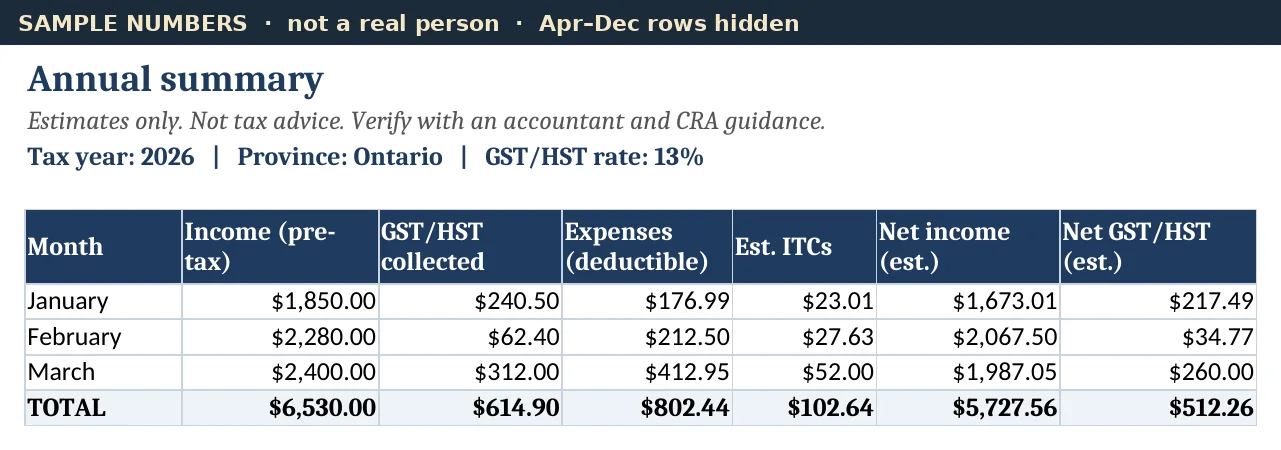
- Every invoice with its GST/HST split out
- Expenses sorted by T2125 line
- Monthly income and profit
- GST/HST collected and paid
The Canada Self-Employed Income, Expense & GST/HST Tracker is a spreadsheet for Excel and Google Sheets. It doesn’t fill in or file your T2125 or calculate CCA; it keeps the totals you copy onto the form.
FAQ
Do I need a separate T2125 for each business?
Yes. Fill in a separate Form T2125 for each business you run, and use separate forms for business income and professional income.
Do I include the GST/HST I charged in my income on T2125?
Include it on line 3A, then take it back out on line 3B (with any PST, returns, allowances and discounts in 3A). If you use the Quick Method, lines 3D to 3F add back the part of the GST/HST you kept.
Where does my T2125 net income go on my tax return?
Line 9946 goes on line 13500 of your T1 for business income, 13700 for professional income or 13900 for commission income. Gross income from line 8299 also goes on line 13499 (13699 for professional income, 13899 for gross commissions).
What if my home office expenses are more than my business income?
You can only claim up to your net income after adjustments (amount 5D), so the home office can't create or increase a loss. The rest carries forward to next year, as long as the workspace still qualifies.
Do I have to claim CCA every year?
No. You can claim any amount from zero up to the maximum for the year. What you don't claim stays in the class, so you can claim it in later years.
Are my drawings a business expense?
No. Money you take out of the business for yourself is a drawing, reported in Part 9 on line 9932. It isn't deducted as salary or wages anywhere on the form.
Sources
- CRA: Form T2125, Statement of Business or Professional Activities
- CRA: Guide T4002, Self-employed Business, Professional, Commission, Farming, and Fishing Income (2025)
- CRA: T4002 Chapter 2, Income (Parts 1 to 3 of Form T2125)
- CRA: T4002 Chapter 3, Expenses (Parts 4, 5 and 7, lines 8521 to 9946)
- CRA: T4002 Chapter 4, Capital cost allowance (Areas A to F, line 9936)
- CRA: Business-use-of-home expenses